The short answer
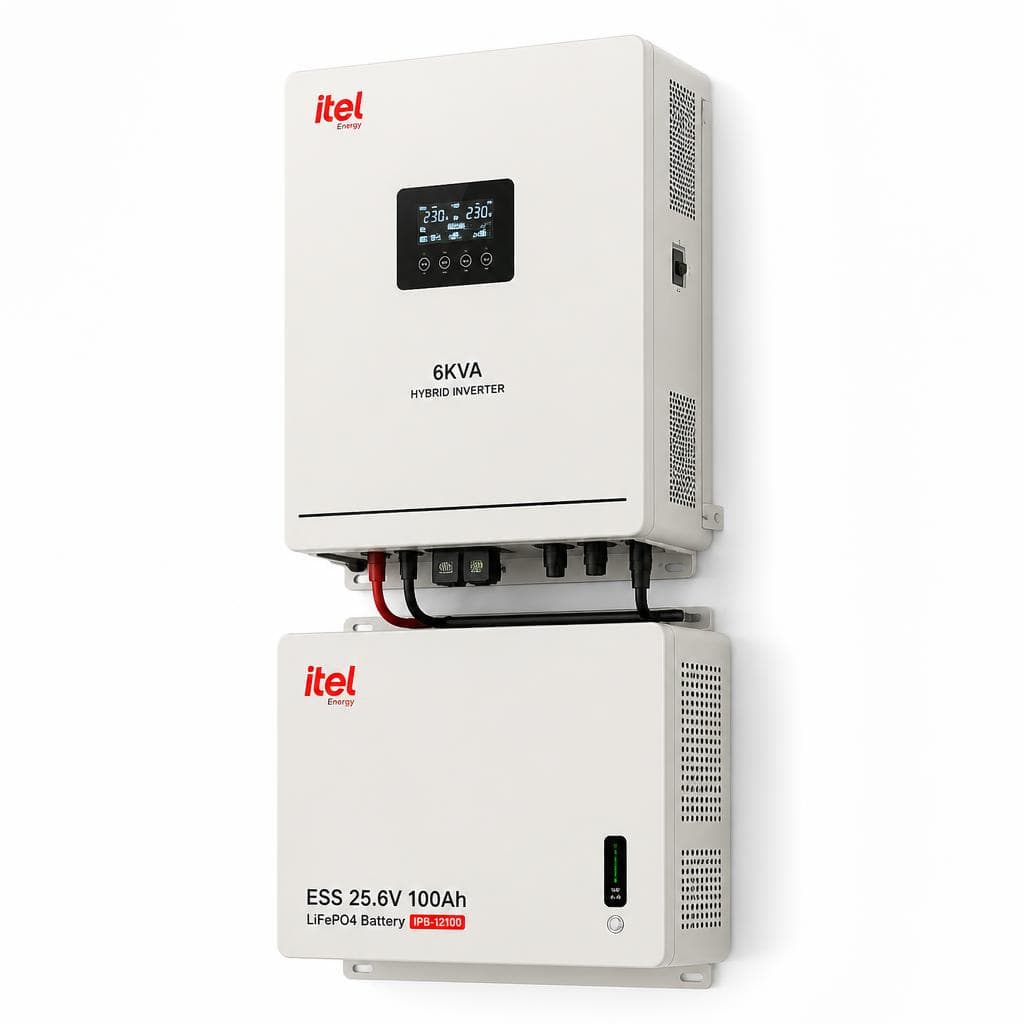
To run one 1.5HP air conditioner alongside normal household loads, most Nigerian homes need roughly a 6kW hybrid inverter, at least 10kWh of lithium storage, and around 3–4kW of solar panels. For two 1.5HP units, budget for an 8kW inverter, 16kWh or more of storage, and 5–6kW of panels.
Those are starting points, not prescriptions. The right answer depends on how many hours the AC actually runs, what else is on at the same time, and whether the unit is an inverter-type AC or an older non-inverter model. Read on for how to work out your own numbers — or send us your appliance list and we will size it free of charge.
Why air conditioners break solar systems
An AC is not just a big load — it is a big load with an awkward shape. Three things matter:
- Running power. A 1HP AC draws roughly 750–900W. A 1.5HP unit is around 1,100–1,500W. A 2HP unit can reach 1,800–2,200W.
- Starting surge. A non-inverter AC compressor can draw three to five times its running power for a second or two at start-up. That momentary spike is what trips undersized inverters, even when the running load looks comfortable.
- Duty cycle. An AC does not draw full power continuously — the compressor cycles. An inverter-type AC modulates instead of switching fully on and off, which both lowers average consumption and almost eliminates the start-up surge. This is why inverter ACs are far easier to run on solar.
Step 1 — size the inverter
Add up everything that will genuinely run at the same time as the AC. A realistic evening in a 3-bedroom home might be: one 1.5HP AC (1,200W), fridge (150W), 8 LED bulbs (150W), TV and decoder (120W), two fans (150W), WiFi and phone chargers (50W). That totals about 1,820W.
Now add headroom for surges — about 25–30% is a sensible working margin, and more if the AC is a non-inverter type. That takes you to roughly 2,400W. A 4kW inverter would technically carry it, but a 6kW gives you room to add a second AC or a pumping machine later without replacing the inverter. That is why 6kW is the common recommendation for a one-AC home.
Step 2 — size the battery
The inverter decides what you can switch on; the battery decides how long it stays on. Multiply your average load by the hours you want, then divide by 1,000 to get kWh.
Running that same 1,820W load for 6 hours needs about 10.9kWh — and that is before conversion losses, which typically take another 10–15%. A single 10.24kWh battery would be tight; 16kWh gives a comfortable evening with margin. If you only run the AC for 3–4 hours before bed and drop to fans overnight, 10kWh is realistic.
Be honest with yourself about the hours. Overestimating AC usage is the most common way people end up paying for battery capacity they never use; underestimating it is how they end up disappointed.
Step 3 — size the solar array
Panels replace what you took out of the battery. In the Lagos area, a panel typically produces around 3.5–4.5 times its rating in watt-hours across a good day — so a 620W panel yields roughly 2.2–2.8kWh daily, less in harmattan or heavy cloud.
To replace 10kWh of overnight use you need somewhere around 4–5 panels of that size working well, and more if you also want to run daytime loads directly from solar rather than the grid. A 3.7–5kW array (6–8 × 620W panels) is the usual range for a one-AC home that wants genuine independence rather than just backup.
You do not have to buy all of this at once. A hybrid inverter runs perfectly well on grid charging alone, so many customers install inverter and battery first, then add panels in stages.
Worked examples
These are illustrative configurations, not quotes. Your own load list will move the numbers.
- One 1.5HP inverter AC, evening use only, plus normal household loads → 6kW hybrid inverter · 10–16kWh lithium · 3.7–5kW panels.
- Two 1.5HP ACs running into the night, family home → 8kW hybrid inverter · 16–32kWh lithium · 5–7.5kW panels.
- One 1HP AC in a small flat, a few hours a night → 4kW hybrid inverter · 5–10kWh lithium · 2.5–3.7kW panels.
- Office with two ACs during working hours only → 8kW inverter · 10–16kWh lithium · larger array, since most consumption is in daylight when panels are producing.
Things that change the answer
- Inverter-type versus non-inverter AC. An inverter AC can cut average consumption substantially and removes the worst of the start-up surge. If you are buying a new AC anyway, buy an inverter model — it will reduce the solar system you need.
- Room size and insulation. An undersized AC in a large or sun-facing room runs constantly and consumes far more than the label suggests.
- How hot the season is. Harmattan and rainy season both cut panel output while cooling demand shifts. Systems sized to the average will occasionally fall short at the extremes.
- Battery age and depth of discharge. Real capacity declines slowly over years, and running a bank hard every night shortens its life.
Get your own numbers
Use our free calculators to work through your specific case: the load calculator to total your appliances, the inverter sizing calculator for the rating you need, and the battery runtime calculator for the hours you will actually get.
A calculator result is an estimate, not a design. For anything involving air conditioning we recommend a proper load assessment before you buy — send your appliance list on WhatsApp and we will go through it with you at no cost, and tell you honestly if a smaller system will do.
Keep reading / take action
Questions about your own setup?
Send us your appliance list on WhatsApp — we'll recommend the right system and share current prices, free.
💬 Chat with Kinbu Power